Choose by material first. Fiber lasers at 1,064 nm mark metals and many engineering plastics with heat. CO2 lasers at 10.6 µm mark paper, board, wood, glass, and many packaging films. UV Lasers at 355 nm mark heat sensitive plastics with almost no heat, a method often called cold marking. Get the material match wrong and no amount of power fixes it. Get it right, and speed, cost, and maintenance become a straightforward comparison.
Key takeaways:
Material first, laser second. The wavelength decides which materials absorb the beam, so the part you mark narrows the choice before budget does.
Fiber is the metal specialist. It engraves and anneals steel, aluminum, and coated metals, and handles some engineering plastics.
CO2 is the organics specialist. It marks paper, cardboard, wood, rubber, glass, and many flexible films, but bare metals reflect it.
UV is the gentle detail specialist. Cold marking suits sensitive plastics, clear plastics, and fine codes on electronics and medical parts.
None of the three uses ink. Running costs are electricity, fume extraction, and occasional optics care, not ink and solvent.
Entry prices sit in clear tiers. Fiber and CO2 systems cost less to buy; UV systems cost more and deliver the finest, lowest heat marks. All figures below are labeled estimates.
Trial on your own parts is mandatory. Additives, pigments, and surface treatments change absorption, so a sample marking test decides, not a catalog.
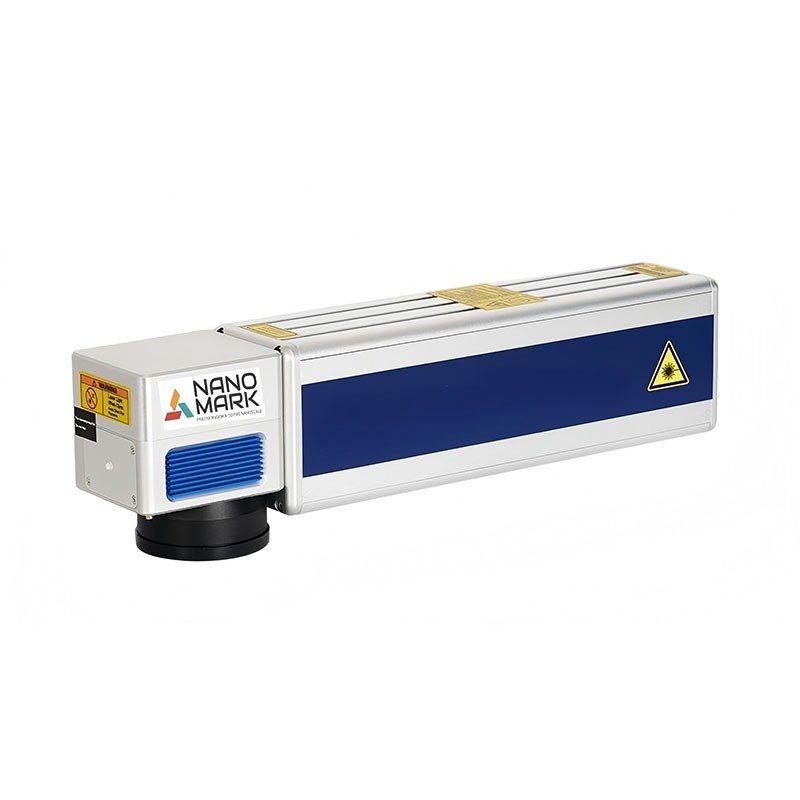
A fiber laser marking machine: the standard choice for permanent codes on metal parts.
A laser marks only the material that absorbs its wavelength. This single physical fact explains nearly every right and wrong laser purchase in the coding industry.
| Laser type | Wavelength | How it marks | Marks well | Struggles with |
|---|---|---|---|---|
| Fiber | 1,064 nm | Thermal: engraves or anneals the surface | Stainless steel, aluminum, coated metals, some engineering plastics | Glass, many commodity plastics, organic material |
| CO2 | 10.6 µm | Thermal: vaporizes a thin layer | Paper, cardboard, wood, rubber, glass, many plastic films | Bare metals that reflect the beam, some clear plastics |
| UV | 355 nm | Photoablation: breaks material bonds with minimal heat | Heat sensitive plastics, clear plastics, electronics, medical device plastics | Deep engraving in metal, which it does slowly |
Two practical notes. First, additives and pigments change absorption, so the same plastic from two suppliers can mark differently on the same machine. Second, coatings can work in your favor: a fiber laser strips paint or anodizing off a metal surface and leaves a high contrast mark in one pass, which is a common product serialization method.
Each technology produces a characteristically different mark, and buyers usually have a preference once they see samples side by side.
Fiber on steel: annealing produces a dark gray to black mark with no material removed, so the surface stays smooth and corrosion resistant. Deep engraving is available when the mark must survive abrasion, such as serial numbers on tools.
CO2 on organics: paper and board take a light engraved tone; glass takes a clean frosted mark; wood takes a burned mark with visible depth. Contrast is moderate but permanent, and no ink can rub off.
UV on plastics: high contrast without burning or yellowing, and fine detail for small text, data matrix codes, and parts with tight marking windows. This is why electronics and medical device makers lean UV.
If your code must stay readable after cleaning chemicals, abrasion, or outdoor exposure, deep engraving or annealing on metal is the durable route. Printed and surface level marks can degrade under harsh handling, so test the marked part against your real handling chain, not a lab bench.
Speed depends on mark depth, mark area, and how many characters or code modules you print per part. Shallow marks are fast; deep engraving needs repeated passes.
Fiber scans quickly across metal surfaces, which makes it comfortable for line speed coding on metals and for high volume serialization.
CO2 is fast on packaging materials, which is why it appears on film, carton, and label lines where each part arrives and leaves within a fraction of a second.
UV generally marks slower per part than the other two. Factories choose it where quality on a sensitive plastic matters more than raw cycle time.
A worked example keeps the comparison honest. Suppose a line marks a ten character batch code on a steel bracket. A fiber system might deliver that mark in well under a second, a UV system might need several seconds for the same legibility on plastic, and a CO2 system sits between them on organics. Now change the part: a serial number engraved deep enough to survive shot blasting needs many passes and several times that duration on any technology. This is why a single headline speed number means little until your own mark file runs on the machine.
Be careful with any supplier speed figure quoted without your part. The honest way to compare is to send each candidate the same part file and ask for the measured cycle time on that exact material, depth, and code content. Reputable suppliers quote this without hesitation, and the numbers between technologies can close or widen significantly once your real mark is on the table.
Laser marking removes ink and solvent from your consumable budget entirely. The cost structure becomes the purchase price, electricity, and long term component replacement.
| System | Indicative entry price range | Main running costs |
|---|---|---|
| Fiber | Roughly USD 3,000 to 12,000 | Electricity, occasional optics service |
| CO2 | Roughly USD 2,500 to 10,000 | Electricity, laser tube replacement in later years |
| UV | Roughly USD 8,000 to 25,000 | Electricity, diode module replacement in later years |
These are labeled estimates for entry level coding and marking systems, intended for budget framing only. Confirm with suppliers for current pricing, because exchange rates, power ranges, and included accessories move these ranges month to month. Wall power for coding grade systems is modest, often under 1 kW including cooling, and integration hardware such as a conveyor, product sensor, and safety enclosure adds a predictable block to any quote.
One planning tip that saves money: if only one station on your line needs laser quality, laser that station and keep inkjet coders for secondary packaging. Hybrid lines are common, and laser printing machines integrate on the same conveyor logic as inkjet heads.
Laser sources have long service lives, and the figures makers publish are commonly quoted as follows: fiber sources around 100,000 hours, CO2 sealed tubes often 20,000 hours or more, and UV diode modules often in the 10,000 to 20,000 hour range. Treat these as makers' quoted figures; your duty cycle, environment, and cooling quality decide real life in your plant.
The maintenance list is short:
Keep the F-theta field lens clean. Dust and marking fume deposit on the lens over months and quietly reduce mark quality.
Extract fume at the marking point, both for lens health and for air quality on the line.
Follow the cooling specification. Water chilled systems need clean coolant on schedule; air cooled systems need clear vents.
Inspect the galvo scan head window during scheduled stops, and follow the maker's cleaning procedure.
Compare this with an inkjet line, where ink, solvent, filters, and nozzle service are regular line items. That contrast is why many factories move their highest value codes from inkjet to laser, and it applies to all three laser types equally. Ask any supplier for the scheduled maintenance table before you buy; a serious supplier answers with hours per year, not marketing pages.
| Your part | Start with | Notes |
|---|---|---|
| Steel, aluminum parts, tools, nameplates | Fiber | Anneal for smooth surfaces, engrave for abrasion proof traceability |
| Paper boxes, wood, glass bottles, rubber | CO2 | Fast, permanent, no ink to smear |
| Plastic film packaging | CO2, after a film trial | Film grades vary; some films need a specific wavelength to mark dark |
| PCB, cable jackets, plastic housings, medical plastics | UV | High contrast, minimal heat, fine detail |
| Mixed metal and plastic on one line | Pick the primary material, then trial | Or run two heads; a trial on real parts decides |
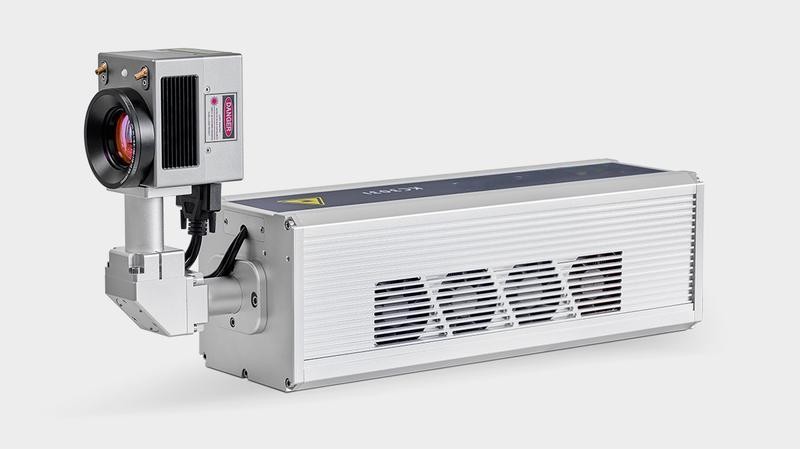
A galvo laser marking system: the scan head and source unit mount over the conveyor or inside a workstation.
Integration follows the same pattern for all three technologies: a conveyor or workstation, a product sensor, encoder feedback if the part moves, and a safety enclosure. A coding grade laser system ships as a Class 1 enclosed unit with interlocks, so the embedded Class 4 laser is safe for operators without laser safety training. For UV specific applications, review the UV Laser marker configurations, and for CO2 film and packaging work, start from the CO2 product pages linked above.
Partly. A fiber laser covers metals plus some engineering plastics, and a CO2 laser covers organics plus many films. For sensitive or clear plastics, only UV marks cleanly. Most factories with mixed products either pick the laser for their primary material and use inkjet elsewhere, or run two laser types. A sample marking test on your real parts shows exactly where each machine stops.
UV. Cold marking breaks material bonds with minimal heat, so the plastic keeps its color and surface finish. CO2 works well on many films and some plastics. Fiber burns many commodity plastics and is usually the wrong tool for them.
No ink and no solvent. The recurring costs are electricity, fume filter upkeep, and cleaning supplies for the optics. Long term, a CO2 tube or a UV diode module is a replacement item, while fiber sources are commonly quoted around 100,000 hours of life.
On metals, engraving and annealing are permanent and survive abrasion and cleaning chemicals better than any printed code. On plastics, marks are durable but a surface level mark can lighten under heavy abrasion. If your market has coding durability requirements, such as for medical devices or traceability schemes, test marked samples against those requirements before committing.
Based on commonly quoted source lives and electricity draw, fiber is usually the lowest total cost, CO2 sits close to it, and UV costs more to buy and to keep over a decade. Offset that against what a failed or unreadable code costs your line, and the more expensive machine is sometimes the cheaper decision.
The fastest way to decide is a sample marking test on your own parts. Send two or three representative pieces, your code content, and your target cycle time, and compare the marked samples side by side. NANO MARK runs sample marking tests before every quotation, so the wavelength decision is settled by evidence from your production, not by catalog claims.
Contact: Jason
Phone: +8613337336942
E-mail: [email protected]
Add: Hangzhou City, Zhejiang Province, China