On a food packaging line the date code has to survive condensation, grease, and washdown, stay legible through cold chain handling, and keep pace with fast primary packaging. Four technologies cover nearly every food coding job: continuous inkjet for high speed film and bottles, thermal inkjet for cartons and porous surfaces, laser marking for permanent ink free codes, and large character inkjet for cases and sacks. Choose by surface, environment, and line speed, in that order, and the decision usually makes itself. Most food plants end up running two of the four, one for primary packaging and one for secondary.
Key takeaways:
Continuous inkjet is the default for fast primary packaging. It grips plastic film, bottles, and foil at high line speed and tolerates the temperature swings of a food plant.
Thermal inkjet earns its place on cartons and labels. Water based inks sit well on porous board, run clean, and suit lower speed or intermittent lines.
Laser removes ink from the equation. No consumables and a permanent mark, but the film formulation must respond with readable contrast, so test first.
Large character and high resolution inkjet handle the outside of the case. Batch and pallet data on board and sacks is a different print job from the pack itself.
Wet and cold environments narrow every choice. Washdown ratings, condensation bands, and frozen surfaces rule technologies in or out before price is discussed.
Ask for compliance documentation on every ink. Your supplier should state suitability for food adjacent coding in writing, and confirm it for your exact application.
White pigment ink keeps date codes legible on dark film and dark bottles, where dye based ink disappears.
Start the decision by matching technology to the package and the environment:
| Technology | Strong at | Typical food jobs | Watch out for |
|---|---|---|---|
| Continuous inkjet | High speed, non porous surfaces | Film bags, bottles, trays, pouches | Solvent handling, viscosity upkeep |
| Thermal inkjet | Porous surfaces, clean areas | Cartons, labels, kraft pouches | Lower speed ceiling, printhead life |
| Laser marking | Permanent marks, no consumables | Foil, rigid plastic, formed lines | Film must respond with contrast |
| Large character inkjet | Big porous surfaces | Cases, trays, sacks, pallets | Not for small best before text |
A food packaging line stacks three problems that a general packaging line does not. First, moisture: cold filled bottles sweat, frozen product frosts, and washdown areas get hosed daily, and wet surfaces repel ink that would print perfectly on dry film. Second, speed and changeover: food lines run fast and switch products often, so the coder must hold quality at full speed and take a message change in minutes. Third, traceability pressure: best before and lot codes are audit material, so a smeared code is not a cosmetic issue, it is a blocked pallet.
Add hygiene rules and temperature swings between the filler and the cold store, and the result is simple: on food lines, the coding step fails more often from environment than from the machine. Pick technology for the environment first and the brochure second.
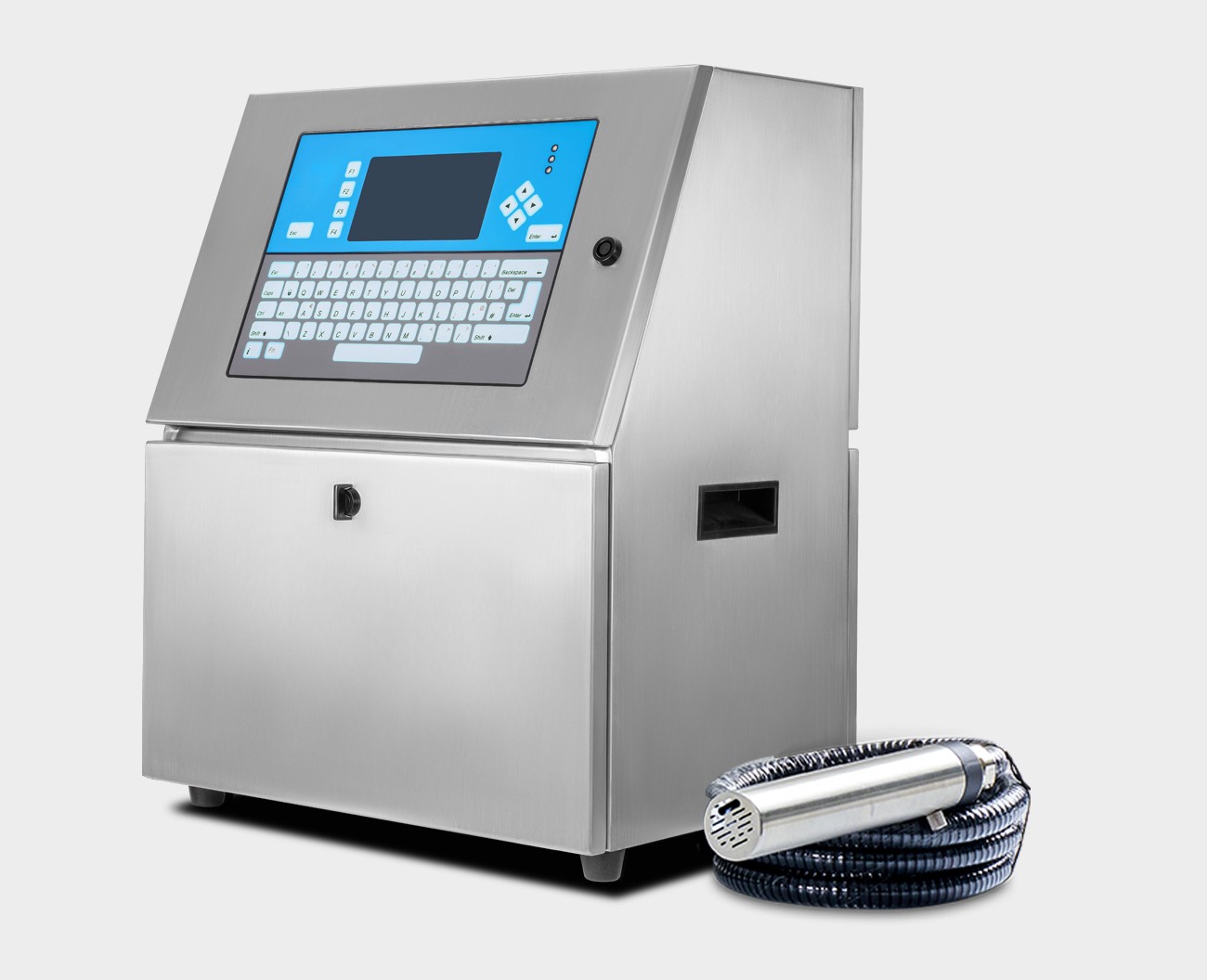
Continuous inkjet, or CIJ, is the workhorse of food date coding. A fast drying solvent based ink grips plastic film, bottles, foil, and most non porous surfaces, and the printhead prints at line speeds that keep up with form fill seal machines and rotary fillers. Specified properly, a small character inkjet coder holds character quality at line speeds up to about 7.5 m/s. The printhead is small and mounts almost anywhere, including tight spaces over a conveyor, and it prints across a 2 to 30 mm gap with the sharpest code near 10 mm, which makes conveyor side mounting forgiving on busy lines.
Two food specific points decide success. On dark surfaces, film, sauce bottles, dark trays, ask for pigment ink such as white or yellow instead of dye based ink, because dye disappears against dark backgrounds. White pigment systems hold their edge through an independent agitation cylinder that keeps the pigment in suspension and multi stage filtration that protects the nozzle. And in cold or humid halls, specify a fast drying ink blend and give the code a few centimeters of open air before the next machine touches it. CIJ asks for routine maintenance, flush cycles and viscosity checks, but modern machines automate most of that. The wider inkjet printing machine range shows how CIJ and high resolution inkjet split the work between primary and secondary packaging.
Thermal inkjet, or TIJ, pushes a water based ink cartridge onto the surface with tiny heaters. It prints a crisp code on porous materials, carton board, paper labels, kraft pouches, and it does so with almost no routine maintenance: no viscosity control, no solvent, and a cartridge swap that takes minutes.
The trade off is speed and surface range. TIJ holds its best quality at moderate line speeds and on porous or coated surfaces, so it is the natural choice for case coding, tray labeling, and secondary packaging lines rather than the fastest film lines. It also runs clean, which matters in bakeries and other food areas where solvent odor is unwelcome. If your coding sits on cartons and paper, TIJ is often the simplest machine on the floor to live with.
A laser coder does not print, it changes the material surface: on foil it removes a thin layer, on plastic film it triggers a color change in the formulation. The result is a code that cannot smear, cannot be washed off, and needs no ink, solvent, or drying time, which is why formed food lines increasingly mark best before data with laser at the sealing station. Wavelength decides the outcome on food packaging: on PET beverage bottles a CO2 laser tuned to the 9.3 micron wavelength marks with far better contrast than the standard 10.6 micron line, because PET absorbs it more strongly, and on laminated paper cartons the 10.2 micron wavelength is the better match. CO2 markers hold quality at line speeds up to 30 m/s, driven by a sealed RF tube rated for roughly 40,000 hours. Where the surface is white or light plastic that heat would scorch, a UV Laser at 355 nanometers marks cold with a spot under 10 microns, fine enough for small date fields on sensitive materials.
The precondition is contrast. The mark only works if the material responds with a readable color change, and that depends on the film formulation and pigment, so the trial step is not optional: send your exact film and ask for a marked sample. Laser suits rigid plastics, foil lids, and many formed packages well, and it keeps running cost low because consumables drop out of the equation. Weigh it against the higher entry price, and compare options across the laser printing machine range with your own samples rather than datasheet photos.
The date code on the shipping case is a different print job from the one on the pack. Cases, trays, and sacks need big, readable batch and date text at a distance, often on dusty or rough board, and small character coders are the wrong tool for it.
Large character valve jet and high resolution inkjet cover this layer. Valve jet printers throw big droplets through wide nozzles that tolerate dust and rough surfaces, which suits sacks and heavy board. High resolution inkjet prints near label quality text and barcodes onto cases at moderate speed, which suits retail ready trays where the case print is customer visible. If your pallet label data is printed rather than labeled, this is where it happens. Coding both layers, pack and case, from one supplier keeps the message data consistent.
Environment can overrule everything above. In washdown areas, the coder housing needs IP65 full stainless construction built for hose down cleaning, or the machine becomes a maintenance story. Near cold fillers, condensation on the bottle is the enemy: either dry the bottles before the coder, code below the condensation band, or specify an ink rated for damp surfaces.
Freezer rooms and cold stores add two more constraints: ink must stay flexible at low temperature so the code does not crack or flake off the film, and the printhead, if it lives in the cold, must be specified for it. Laser marking systems, for example, typically specify an operating window around 5 to 45 degrees Celsius and 10 to 90 percent relative humidity, so near freezer lines the usual plan is to put the marking head in the work zone and keep the controller in the warmer aisle. The practical pattern on most food lines is placement: move the coding station after the dryer or a few meters down the conveyor, and a marginal application becomes a reliable one. When you brief a supplier, describe the wettest and coldest hour of the line, not the average one.
Ink on the outside of a sealed pack is food adjacent, not food contact, and the rules differ. Still, food plants are right to ask what is being sprayed onto their packaging, and auditors increasingly ask with them.
Make three requests in writing from your supplier: a statement of the ink suitability for food packaging applications, the datasheet with drying and temperature behavior, and confirmation for your specific surface and temperature range. If your pack design codes near a food contact zone, such as inside a lid or on a liner, say so explicitly, because that changes the ink conversation entirely. For dark packaging, request the compliance paperwork for white pigment ink at the same time, since dark film is where most food brands end up needing it. None of this rules technologies in or out, it just prevents a retrofit conversation after an audit.
| Your package | Start with |
|---|---|
| Plastic film bags and pouches at speed | Continuous inkjet, fast drying ink |
| Dark film or dark bottles | Continuous inkjet with white pigment ink |
| Cartons, labels, kraft board | Thermal inkjet |
| Foil lids and rigid plastic | Laser, after a film trial |
| Shipping cases, trays, sacks | Large character or high resolution inkjet |
| Wet or frozen surfaces | Whatever survives testing on your actual line |
Two technologies cover most food plants: one CIJ on primary packaging, one TIJ or high resolution machine on the case. Modern controllers absorb the product switching by storing a message library of preset formats, room for 68 stored messages on production units, so an operator changes products without retyping a line. Keep the message data identical across both, so the date a consumer reads on the pack matches the date your warehouse reads on the case, and run a quarterly code audit on both layers.
Continuous inkjet with a fast drying, flexible ink is the common choice, because frozen film often carries frost and static. Ask for a trial print on your actual film at freezer temperature, and check the code after flexing the bag, since stiff inks can crack on frozen film.
Often yes, but only if the film formulation responds with a readable color change. Pigments and additives decide the contrast, so send your exact film for a marked sample before choosing laser over inkjet.
A white or yellow pigment ink, which is standard work for continuous inkjet. Dye based inks disappear against dark glass and film, so specify pigment when you brief the supplier and ask for the compliance paperwork with it.
Codes on the outside of sealed packaging are food adjacent rather than food contact, but requirements tighten near contact zones such as lids and liners. Ask your supplier for a written suitability statement for your exact application.
After the dryer if you have one, or below the condensation band on cold filled bottles, with a housing rated for the washdown it will receive. Placement solves more wet line coding problems than ink choice does.
The fastest way through this decision is a sample run: send your films, bottles, and cartons, state your line speed and the wettest hour of your line, and ask for printed samples from each candidate technology. NANO MARK reviews food line coding applications directly, and samples on your own packaging settle surface, ink, and placement in one pass.
Contact: Jason
Phone: +8613337336942
E-mail: [email protected]
Add: Hangzhou City, Zhejiang Province, China