Most buyers who regret a date coding machine purchase made one of seven predictable mistakes: they chased the cheapest quotation, skipped the trial print on their own packaging, guessed at line speed and duty cycle, ignored consumable and service costs, forgot integration and environment requirements, bought a machine their operators struggled to run, or signed with no plan for changing code requirements. Every one of these is visible before purchase, and every one is cheap to prevent. The machine price is only a fraction of what you will spend over five years of ink, solvent, and downtime, so the buying process deserves the same rigor you apply to any other line equipment.
Key takeaways:
Total cost beats sticker price. Over five years, consumables and downtime usually cost more than the machine itself, so compare quotations on running cost, not purchase price.
A trial print on your own material is non negotiable. Adhesion and sharpness depend on your exact film, bottle, or carton, never on a demo sample alone.
Buy for your fastest line and worst shift. A coder that looks fine on a demo bench can fail at full production speed or during the second shift.
Ask for consumption numbers early. Ink, solvent, and filter use per operating hour turns vague running cost into a comparable figure.
Integration details decide install time. Line drawings, mounting space, and washdown ratings shared before purchase prevent rework after delivery.
Match machine complexity to your operators. Features nobody uses become errors on the line.
Leave room for what comes next. Traceability data and two dimensional codes are moving from optional to expected, and a minimal coder caps you there.
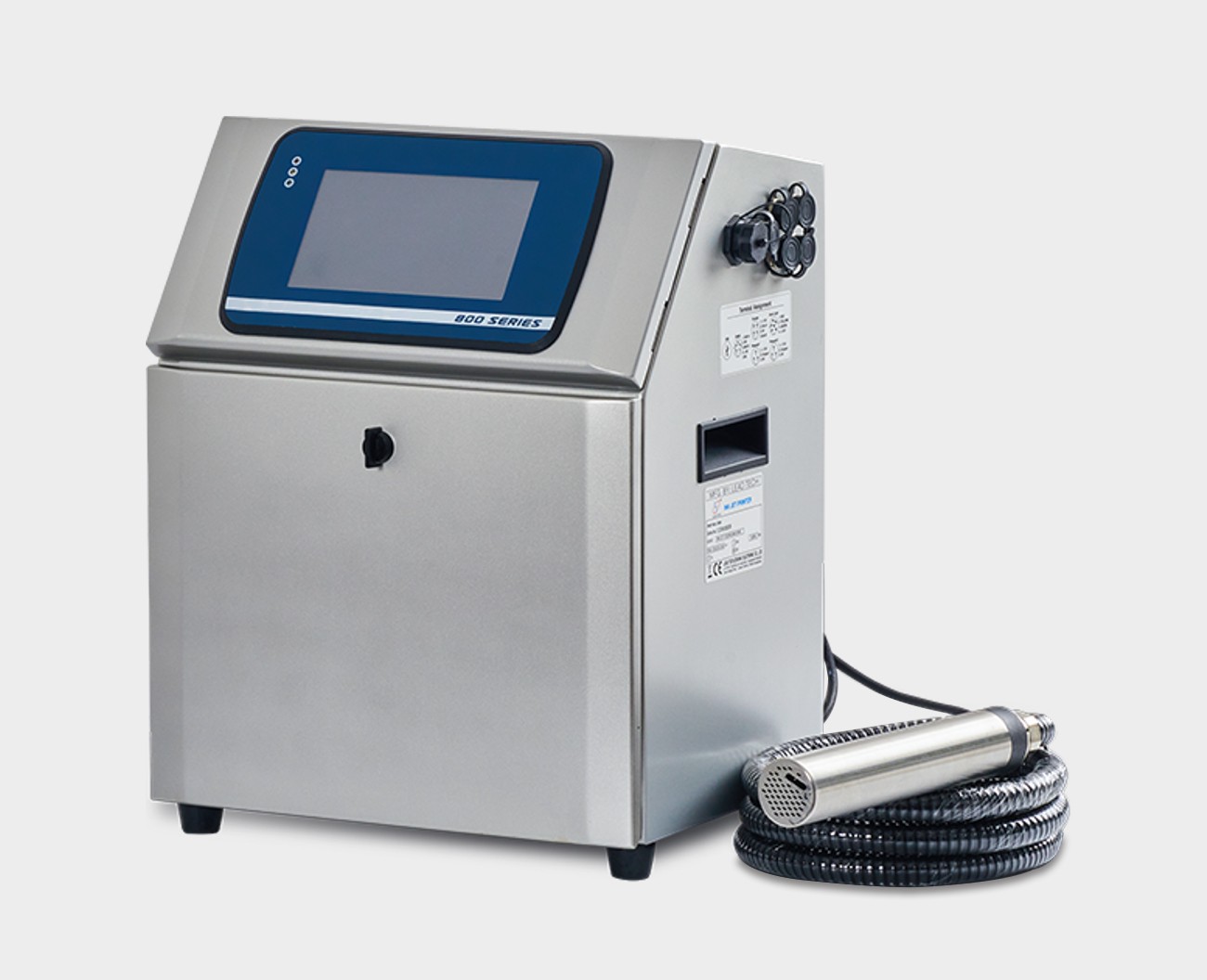
A touchscreen date coding machine: plain language menus and message previews reduce operator errors at the line.
Before you sign anything, walk this table with the salesperson in the room:
| Mistake | What it costs later | Prevention before you sign |
|---|---|---|
| Cheapest quotation wins | Higher consumable spend, slow service response | Compare five year cost, not machine price |
| No trial print | Codes that smear, fade, or fail audits | Send your own packaging for a sample run |
| Speed and duty guesswork | Stretched codes, mid shift faults | Test at your real top speed and shift length |
| Consumables ignored | Surprise cost per thousand codes | Get ink and solvent use per operating hour |
| Integration forgotten | Install delays and rework | Share line drawings, ratings, and space limits |
| Operator mismatch | Unused features, wrong messages on packs | Put your actual operator on the demo unit |
| No growth plan | A coder that cannot print what comes next | List the code types you expect to need |
The purchase price of a date coder is the smallest number in the deal. Entry level continuous inkjet machines typically start in the low thousands of dollars, while integrated high speed systems run several times that, but the spread narrows once you total five years of ink, solvent, filters, and service visits. Treat every quotation as an opening position in a conversation about total cost of ownership.
Ask each supplier for three figures: consumable consumption per operating hour, the service interval the schedule assumes, and the response time the service contract guarantees. A quotation that omits these is not cheaper, it is less complete. Also check what the price includes, because installation, startup training, and the first set of filters are line items that cheapest quote wins style offers often leave out. Confirm current pricing and what it includes directly with the manufacturer before you compare.
Adhesion is decided by the exact surface, not by the material family. Two polyethylene films with different slip additives accept the same solvent ink differently, and a carton board from a different mill can turn a crisp code into a feathered one. The only evidence that counts is a code printed on your packaging.
Send your actual films, bottles, and cartons to the supplier and ask for sample prints made at your line speed. When the samples arrive, test them the way your supply chain treats them: refrigerate them, abrade them lightly, stack them under weight, and read them after a day. If you code dark surfaces, ask for the test in a pigment ink such as white or yellow rather than a dye based ink. A supplier who will not run this test before purchase is telling you something useful.
A coder on a demo bench prints onto a clean sample moving at a comfortable speed. Your line runs faster, longer, and dirtier. Two numbers decide whether the machine you buy keeps up: the maximum line speed at which the coder still holds character quality, and the duty cycle it can sustain across your shift pattern. For orientation, small character inkjet coders hold character quality at line speeds up to about 7.5 m/s, fiber laser markers keep quality up to 20 m/s, and CO2 laser markers reach 30 m/s, which is why the fastest beverage and cartoning lines usually end up with laser.
Give the supplier your real top speed in meters or packs per minute, and ask for a print sample made at that speed, not at a demo setting. If your line speed varies, or if products arrive unevenly, plan for encoder feedback from day one, because a coder guessing at speed produces stretched or compressed characters. Then state your shift pattern honestly. A machine sized for intermittent use will not survive a three shift food or beverage line, and buying for the average shift instead of the hardest one is how buyers end up with a coder that faults at two in the afternoon.
Every inkjet date coder keeps drinking after you buy it. Ink, solvent, makeup, filters, and wiper parts arrive on a schedule whether you watched the price or not, and on multi shift lines these costs overtake the machine price well inside five years.
Make suppliers quote consumption per operating hour, then convert it to the number you will actually manage: cost per thousand codes. That single figure makes machines comparable regardless of ink pricing games, bottle sizes, or dilution claims. Ask which parts are user replaceable and which need a technician, because a filter change you can do in ten minutes and a visit you must book are very different costs. The design details that keep these numbers low are visible in the specification sheet: the print head orifice is a 60 micron gem nozzle with thermostatic control, so multi stage filtration before the nozzle decides how long it lives, automatic flushing at start up and shut down removes the manual cleaning that eats morning shifts, and real time ink monitoring can cut make up fluid consumption by up to half. If any of these appear as paid options rather than standard features, price them into the comparison. Finally, weigh the service terms: response time, spare parts availability in your region, and whether remote diagnostics are included. The cheapest machine with the weakest service network is rarely the cheapest machine by year three.
A date coder does not stand alone, it bolts into a line that was probably designed before you invited it. Buyers who omit integration from the purchase conversation pay for it during installation, in rework, or in uptime.
Before you order, share your line layout and ask the supplier to mark where the print head, sensor, and conduit go. Confirm the mounting space and print distance with real numbers: small character print heads work across a 2 to 30 mm gap with the sharpest code near 10 mm, so measure the gap on your own conveyor including package bounce, and if you code bottles or tubes, ask about a print head with the 30 degree angled nozzle built for curved surfaces. Check the environment rating against actual conditions: a washdown area needs IP65 full stainless construction rather than a painted cabinet, a dusty flour area needs protection that ordinary office grade equipment lacks, and a freezer pack off area needs ink that stays flexible at temperature. Decide the trigger and encoder signals early. None of this is expensive to plan and all of it is expensive to retrofit.
The most capable coder on the market still prints the wrong batch code if the operator cannot find the right message. Buyers routinely overbuy capability and underbuy usability, then pay for it as mislabeled product, rework, and operator workarounds.
Put the person who will actually run the machine in front of the demo unit and watch them create a message, change a date, and clear a fault. Favor machines that store your message library under plain names, that preview the code as it will print, and that walk through faults in plain language. Touchscreen interfaces have made this easier across the market, but interfaces still differ more than datasheets admit. Include real training days in the purchase, not a startup handshake, and ask how software updates and message backups work before the machine ships.
Code requirements grow. A line that prints a single best before line today may need lot data, shift codes, or a two dimensional code for traceability next year, and regulatory and retailer expectations keep pushing in that direction. A coder bought only for today prints only today.
Before you sign, write the list of code types you expect over the next three years: more lines of text, more variable fields, barcodes, or camera verifiable codes. Ask which of these the quoted machine handles today, which need options, and which need a different machine. Also ask where the ceiling is on message length and print resolution, because those two limits are the ones that bite when a retailer audit adds a requirement. Buying twenty percent more capability than you need today is usually the cheapest insurance in the quotation.
Run the conversation through this list and the seven mistakes stay avoided:
| Question to ask | The answer you want |
|---|---|
| What is consumable cost per thousand codes at my speed? | A number, with the assumptions stated |
| Can you print a sample on my material at my line speed? | Yes, before any payment |
| What happens to code quality at my top speed? | A sample, not an assurance |
| Which parts do I replace, and on what schedule? | A written schedule with prices |
| What environment rating does this unit carry? | A rating matched to my line area |
| Which future code types can this machine add? | A list, separating standard from optional |
| What does startup training include? | Named days with your operators |
Current generation small character inkjet printers handle the viscosity control, automated flushing, and message management that prevent most of the daily tuning described above, and comparing across the full coding machine range before you commit is the single cheapest step in this whole guide.
Entry level continuous inkjet coders typically start in the low thousands of dollars, and integrated high speed systems run several times more, while five year consumables often exceed the machine price. Treat any figure as indicative and confirm current pricing and included items directly with the manufacturer.
Continuous inkjet suits high speed lines and non porous surfaces like plastic film and bottles. Thermal inkjet suits cartons, labels, and porous board at lower speeds, with cleaner operation and simpler maintenance. Your surface and line speed, not brand loyalty, should make the call.
Your actual packaging material, printed at your real line speed, in the exact ink proposed. Then test the samples under refrigeration, abrasion, and stacking before you accept them.
Ask each supplier for ink and solvent consumption per operating hour, then convert it to cost per thousand codes at your line speed. That figure cuts through bottle size and pricing differences and is the only fair comparison.
Usually yes. Ask what response time the contract guarantees, which spare parts sit in your region, and whether remote diagnostics exist. On multi shift lines, a day of downtime erases the savings from skipping coverage.
The cheapest part of any date coding purchase is a requirements conversation before the deposit. Send your packaging material, line speed, shift pattern, and the code content you expect to need, and ask for a sample print and a five year cost picture in return. NANO MARK reviews line requirements directly, and a sample print on your own material settles most of these questions in one pass.
Contact: Jason
Phone: +8613337336942
E-mail: [email protected]
Add: Hangzhou City, Zhejiang Province, China